Between now and February we have an audience with the myths of Inanna and Ereshkigal, with Persephone and Hades. Venus takes her underworld journey in four ways:
- Her conjunction with Pluto is to join with Hades, lord of the underworld (occurs 11 and 25 December).
- She is retrograde: her significations turn inwards, becoming less affective in the world in a positive outgoing manner (Begins 19th December).
- She disappears under the beams of the sun which means she is not visible because of her closeness to our star. This is her underworld journey proper- she cannot be found in the sky day or night so that is where she has gone. (Beginning to mid-January. depending on your latitude).
- She is in Capricorn, the detriment of the Sun, at the winter solstice: it is the place of the longest nights, and it lacks the Sun’s heat and light.
She may as well be stood at a crossroads.
Fetch your pomegranates for Persephone, your persimmons from Rossetti
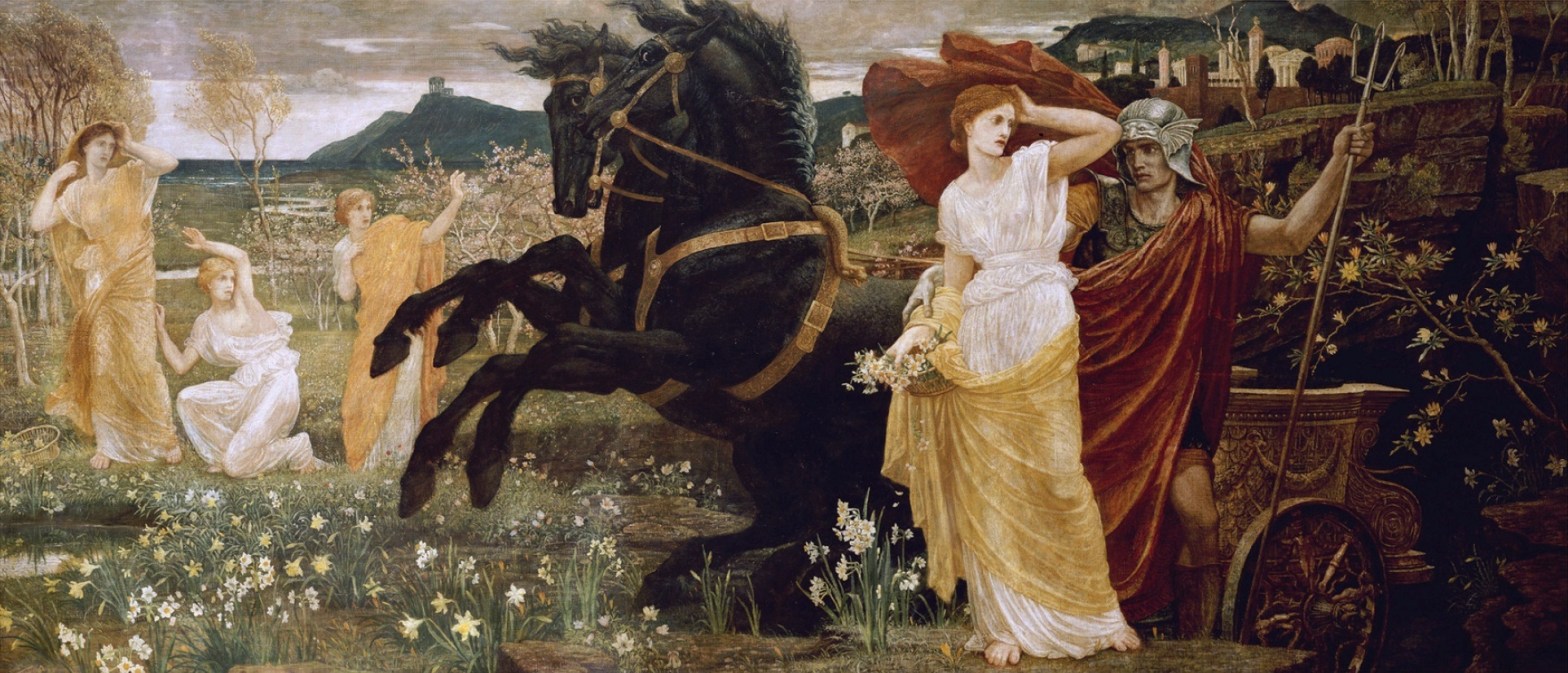
Persephone is picking Narcissus flowers (Daffodils) when she is abducted by Hades who knows that her mother, Demeter, would not permit her to go into the underworld. Demeter searches the Earth for her with Hekate’s torches, all the while withholding everything on the Earth from growing. Helios, who sees all, tells her where she has gone. The people are hungry and their cries cause Zeus to tell Hades to release Persephone, which he does, but not before tricking her into eating pomegranate seeds. Her consuming the foods of the underworld bind her to it, and she must spend half of the year in Hades, her return brings joy to her mother Demeter, goddess of fertility, growth, and agriculture, and so spring begins. Winter returns at her mother’s sorrow when she must go below.
My child, tell me, surely you have not tasted any food while you were below? Speak out and hide nothing but let us both know. For if you have not, you shall come back from loathly Hades and live with me and your father, the dark-clouded son of Cronos and be honoured by all the deathless gods; but if you have tasted food, you must go back again beneath the secret places of the earth, there to dwell a third part of the seasons every year: yet for the two parts you shall be with me and the other deathless gods. But when the earth shall bloom with the fragrant flowers of spring in every kind, then from the realm of darkness and gloom thou shalt come up once more to be a wonder for gods and mortal men.
Homeric Hymn to Demeter
The Sky Above you now
This month Venus almost escapes Pluto, passing him by, only to fall retrograde into his domain. The approaching Sun, like the torches of Hekate in her mother’s hands, or Helios who tells Demeter, reveals her to be in the underworld. Then a crack in the land opens to receive her back to the starry sky. She emerges as Venus morning star (Lucifer) A herald for the strengthening Sun with the quickening close at hand and the coming spring; Persephone threading the land with flowers as her feet pass to show her return. Are you enchanted yet? I know I am.

“We must not look at goblin men. We must not buy their fruits: Who knows upon what soil they fed. Their hungry thirsty roots?”
Christina Rossetti, The Goblin Market
Image: Venus Verticordia (changer of the heart) by Dante Gabriel Rossetti. She holds cupid’s arrow to her own heart, surrounded by the intoxicating honeysuckle, and rose to invoke passion. Paris’ apple is in her hand, but it may as well be the fruit of the tree in Eden or a pomegranate from Hades.
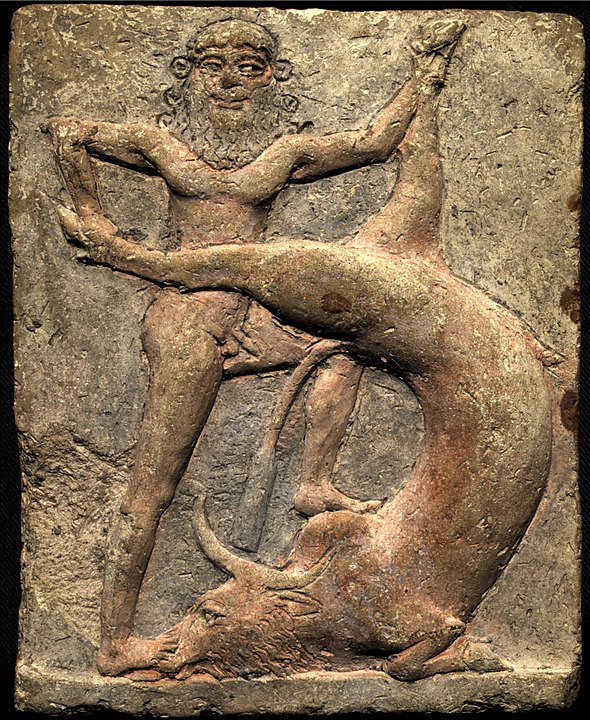
The Descent of Inanna (Ishtar) Sumerian Myth
Inanna, the Queen of Heaven, loves and is spurned by Gilgamesh. In a fit of anger, she seeks revenge, unleashing the Bull of Heaven upon him and his companion, but the Bull of Heaven is killed by the pair. The Bull of Heaven is the husband of Ereshkigal, Queen of the Underworld, and Inanna’s Sister. Inanna visits Ereshkigal’s realm to attend the Bull of Heaven’s funeral, but she is fearful of her sister, having caused his death, and also because none can leave the underworld.
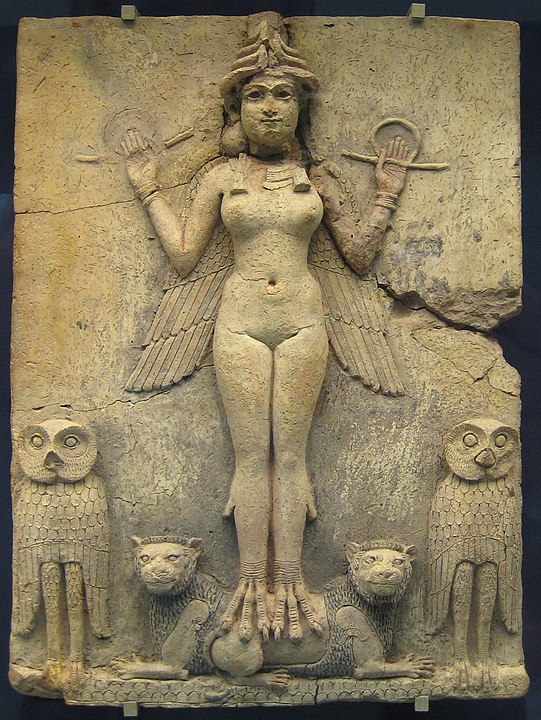
Inanna must pass through seven gates and at each is stripped of her finery: the Crown of Heaven, her jewelry, breastplate, golden ring, sceptre, and clothes. Ereshkigal punishes her transgressions by killing her and hanging her rotting corpse on a hook. Inanna’s servant Ninshubur sends two transgender beings to rescue her. Seeing Ereshkigal’s pains of labour they sympathize with her, and for their kindness, she grants them a wish; they wish for the body on the hook. Reviving Inanna with the waters of life and food, they take her to the realm above, but because no one can leave the underworld they must find a replacement for her. While Inanna’s relatives are all found mourning her death, her lover Dumuzi is not, and she sends him below as her replacement as punishment. Dumuzi’s sister, Gehstinanna, pleads with Inanna to go in his stead. They agree that Dumuzi and Gehstinanna will spend half the year each in the underworld.
The Sky Above You now
Venus combust at the death of the year is as apt, she will have all her attire as evening star stripped from her; her bright crescent waning through December. In the final crescent of our lives, we have our possessions, our identities, our connection with the world taken from us. We must let go. This is melancholy, and melancholy is a Pluto thing. The ephemeral nature of life gives it its meaning and value; both Venusian qualities.
All set on the Capricorn stage of the cavernous underworld. Pluto’s retaining, destructive and transformative qualities mirror that of Inanna’s encounter with Ereshkigal, and the price of her return, her replacement, mirrors the transactive aspect of Venus and Pluto. Venus will be reborn naked as the dew in January, as the youthful buoyant light bringer, Lucifer, the morning star. She will be Persephone returning to her mother, who will usher in the spring.
I hope you are enjoying reading the eternal myths of the stars as they play out in real-time. Just as each retelling in an oral tradition is unique, so is the configuration in the skies.
More to come on mundane world examples, and how to embody the moment in the most positive and useful way.
Title image: Walter Crane The Fate of Persephone
 Astrology Imaginarium